

Baranaja Farming – Uttarakhand’s Hidden Secret
Introduction
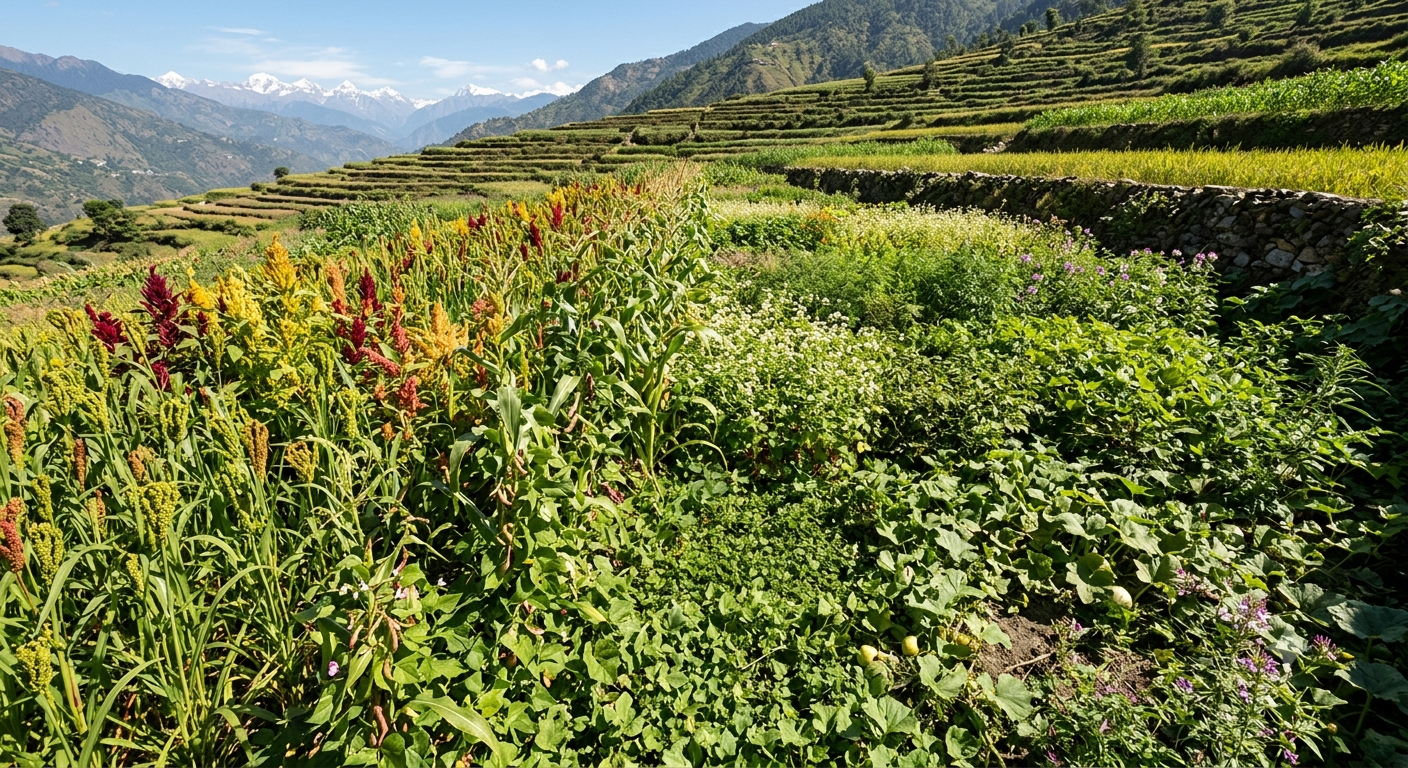
Baranaja farming is a traditional, ancient and climate-resilient multiple cropping system in Uttarakhand where farmers grow twelve crops together like millets, pulses, and oilseeds in a single field without chemical fertilizers. It has been used in the Garhwal and Kumaon regions of Uttarakhand for centuries. Local farming communities consider it a part of their ancestral heritage, with historical roots stretching back hundreds of years as an “organic by default” survival strategy in the fragile Himalayan terrain. This ensures that soil fertility is maintained and year round food security is also there.
Benefits
The name ‘Baranaja’ itself means 12 crops. Climbing bean plants use the strong stalks of grain crops for physical support while roots hold mountain soil firmly. This creates a natural support. The method avoids chemical pesticides or fertilizers, relying entirely on natural ecological balance and traditional wisdom thus becoming organic by default.
This has a host of benefits for farmers. One of the major advantages is that it protects the farmer’s family from erratic weather conditions and complete single crop failure. Legumes fix nitrogen in the ground, naturally enriching the soil and keeping it fertile across seasons. It secures a balanced, healthy supply of food grains, vegetables, and medicinal plants for local households throughout the year.
Planting up to 12 or more different species creates a dense underground web. Deep-rooted tall grains and shallow-rooted legumes together grip the mountain soil firmly at multiple depths, holding it in place against heavy rains. Planting up to 12 or more different species creates a dense underground web. Deep-rooted tall grains and shallow-rooted legumes together grip the mountain soil firmly at multiple depths, holding it in place against heavy rains. Creeping pulses, beans, and cucumbers crawl across the ground, acting as a natural green mulch. This leaves virtually no bare ground exposed to wind or water runoff. Crop wastes and green manure left in the fields naturally decompose. This enriches the soil with organic matter, making it porous and sponge-like so it absorbs water rather than letting it wash down the slopes. Baranaja is practiced on traditional stepped mountain terraces. Combining dense multi-cropping with contour farming drastically reduces the velocity of downhill water runoff. All these factors help in preventing soil erosion drastically.
Baranaja for the future
Modern researchers view this ancient system as a highly effective blueprint to combat global warming for several reasons.
Zero-Emission Farming: The system relies completely on natural biodiversity instead of chemical fertilizers. This eliminates the massive carbon footprint associated with chemical manufacturing.
Carbon Sequestration: The dense root networks and continuous green mulch trap high amounts of carbon dioxide in the soil, preventing it from escaping into the atmosphere.
Water Conservation: The rich organic matter helps mountain soil retain moisture during prolonged heat waves, reducing the need for artificial irrigation.
Extreme Weather Resilience: Monoculture crops easily fail during sudden droughts or unseasonal rains. Baranaja ensures that if one crop perishes, others survive, securing the food supply.
No Comments