

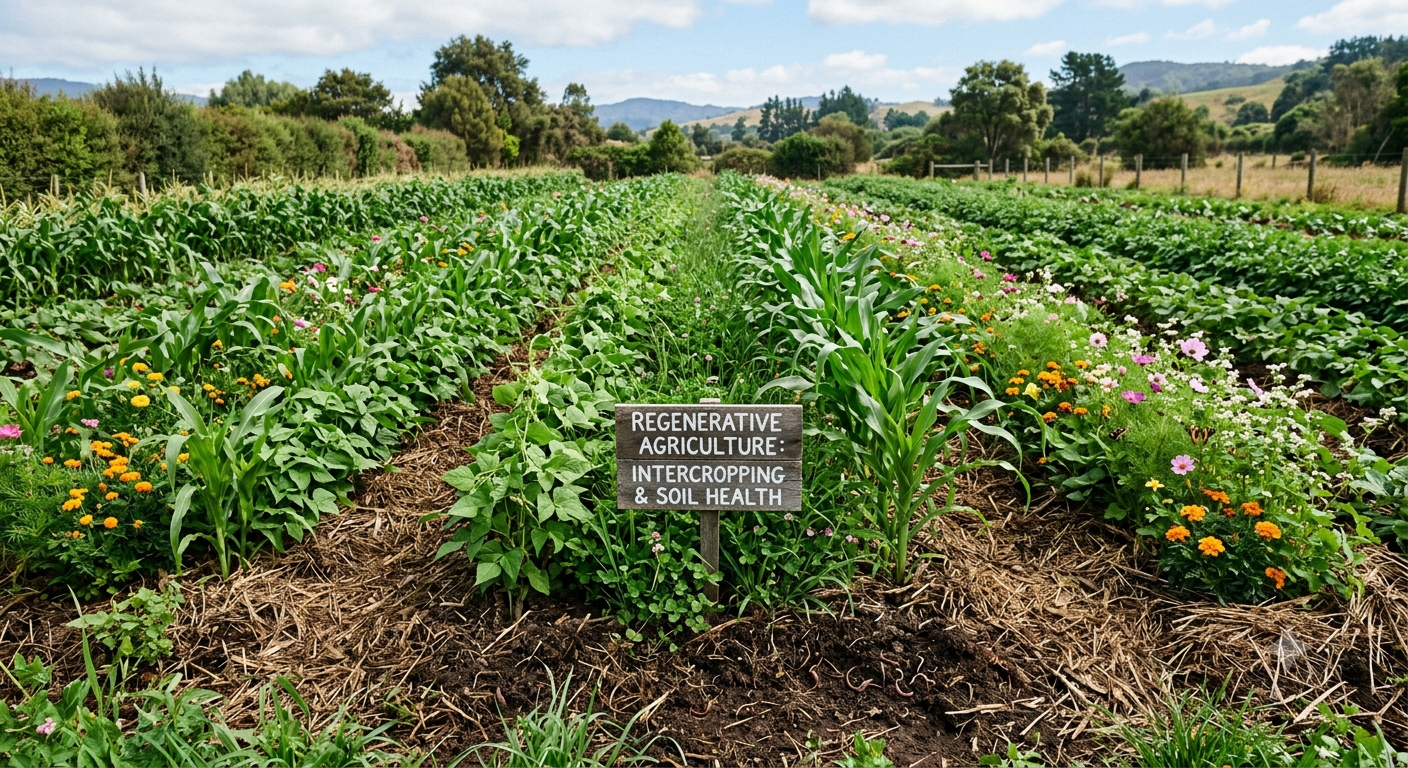
Regenerative farming
Regenerative farming is a way of growing food that restores soil health, increases biodiversity, and fights climate change by working with nature instead of fighting it. The term was coined and popularised by Robert Rodale of the Rodale Institute in 1980’s.
Principles
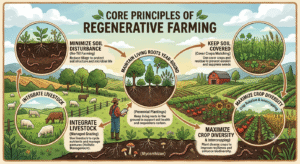
It’s core principles are nothing but the amalgamation of centuries of traditional and indigenous farming methods. There are 5 core principles of regenerative farming as described below
In simpler terms, think of conventional farming like a house where the kitchen is stocked entirely by ordering fast food. It works for a while, but it’s expensive, produces a lot of trash, and might not be healthy long-term.
Regenerative farming is like building a thriving backyard garden and composting your scraps. The system feeds itself, gets healthier over time, and doesn’t rely on outside deliveries to survive.
Should Indian farmers make the switch?
Before the Green Revolution, farmers in India were already implementing all the above mentioned principles since thousands of years. With the advent of Green Revolution came the rampant use of chemical pesticides and heavy reliance on synthetic fertilizers to protect crops and boost growth. This, along with heavy pumping of ground water, led to severe long-term soil damage, pollution and dropping water tables. Farmers abandoned traditional local crops to grow only wheat and rice, shrinking crop variety and causing loss in biodiversity. Overusing chemical fertilizers destroyed natural soil nutrients and made the land less fertile. · Toxic pesticides also leaked into drinking water supplies, leading to rising cancer rates in rural communities. Farmers couldn’t afford hybrid seeds, machinery leading to debt and financial gains were seen only in concentrated regions like Punjab and Haryana. The focus on wheat and rice reduced the farming of protein-rich pulses and iron-rich millets, unbalancing diets and causing overall poor nutrition.
Coming to the current scenario, if we try to implement regenerative farming there can be many major concerns. Firstly, India has a population of over 1.4 billion people to feed. We cannot afford to risk our food security based on an idealistic farming model.
If we talk about the transition dip, when a farm switches from chemical to regenerative practices, the soil needs 2 to 3 years to rebuild its natural fertility. During this time, crop yields frequently drop. Nearly 86% of Indian farmers are small and marginal landholders who live harvest-to-harvest. They do not have the financial cushion to survive a single bad season, let alone three years of low yields. Without heavy government cash payouts, this model will break the back of the small farmer. Regenerative farming is labour-intensive and complex. It requires precise management of cover crops, crop rotation, and composting. In India, where there is already a massive shortage of agricultural labour and a lack of training infrastructure, asking millions of uneducated farmers to suddenly become ecosystem experts is highly unrealistic. Without massive chemical fertilizers, our overall national food production could plummet, triggering inflation and food shortages. It sounds good in theory, but it is deeply impractical for a country of India’s size.
Conclusion
So, to conclude, the ideal path should be a phased transition. Large corporate agri-businesses and government must step up to fund farmers during the 3-year transition phase using modern tools like carbon credit payouts and AI-driven soil tracking. Regenerative agriculture is highly beneficial for India, but only if executed with a strong financial safety net for the small farmer.
No Comments