

Food safety and hygiene for consumers
In today’s times, food safety and hygiene have become some of the most widely discussed issues in India. Although rules and regulations relating to food safety and hygiene are in place, it is unfortunate that people continue to face difficulties because of their ineffective implementation.
During this festive season, when we go out to eat at restaurants or buy sweets at a sweet shop, it is extremely important for us, as consumers, to pay attention to certain important aspects in order to ensure our own good health and safety.
What Should Consumers Check at Restaurants?
1. Verification of the FSSAI License Number
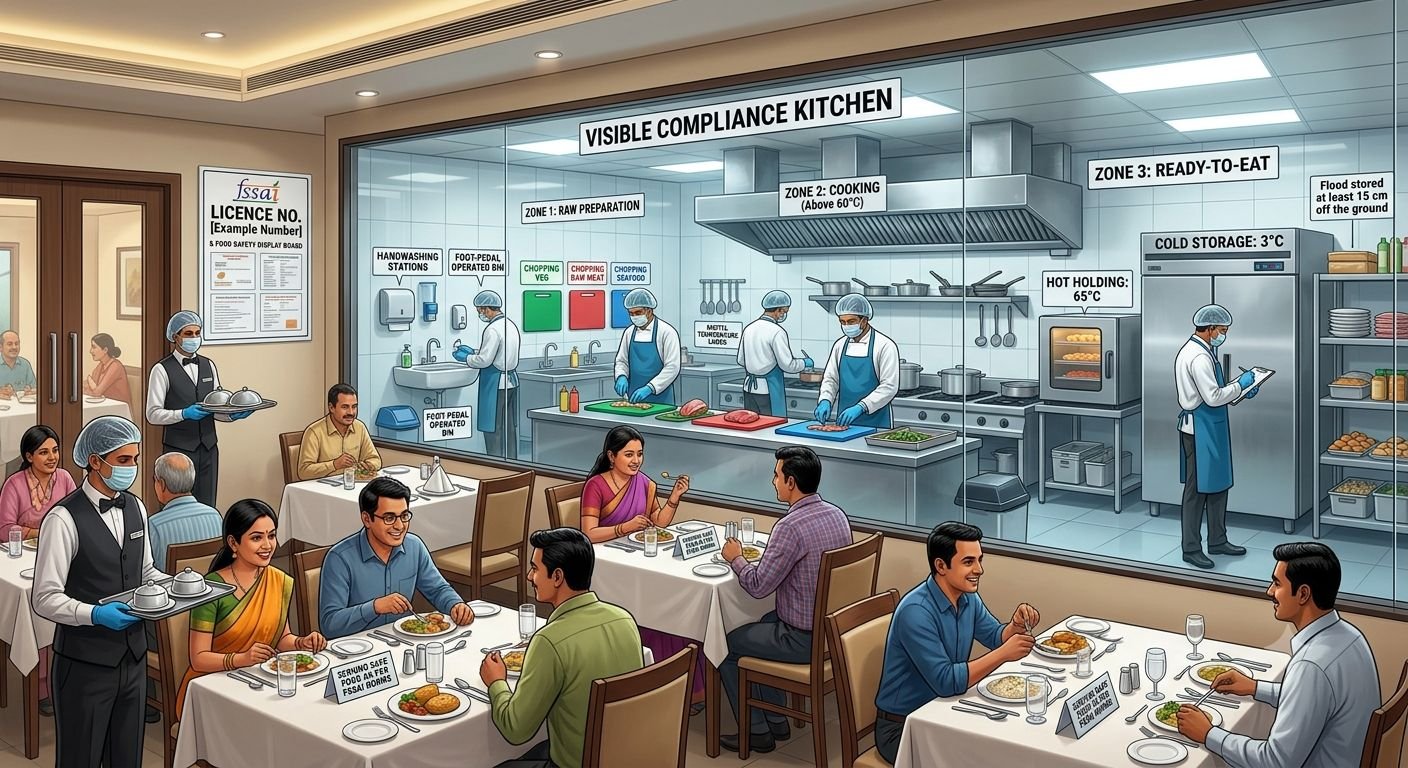
According to the FSSAI Rules, 2011, the restaurant’s 14-digit FSSAI number should be clearly displayed at the main entrance. In addition, a copy of the FSSAI license certificate should be prominently displayed in the main area of the restaurant. The FSSAI number must also be printed on every bill issued to the customer.
2. Hygiene of Food-Handling Staff
All employees who directly handle food in a restaurant should be wearing clean uniforms, caps or hairnets, face masks, and gloves. If an employee has a beard longer than 2 mm, a beard mask should be used.
Employees handling exposed food should not be permitted to wear jewellery or watches. Head coverings worn for religious reasons are permitted, but the hair underneath must be completely covered.
3. Drinking Water Arrangements
The restaurant should have an appropriate supply of treated/RO potable drinking water, or sealed packaged drinking water conforming to the standards of IS 10500 should be available. Information regarding the drinking water facility should be clearly displayed for customers.
4. Clean Hand-Washing Facilities
The restaurant should have a separate and clean hand-washing area. It must be equipped with a liquid soap dispenser, running water, and a clean facility for drying hands.
5. Be Cautious About the Quality of Paneer
The Government of Gujarat has prohibited the manufacture, storage, transportation, distribution, and sale of non-standard analogue paneer, cheese, and butter.
Consumers can also carry out some basic checks themselves to assess the quality of paneer. Genuine paneer is generally soft, slightly grainy, and somewhat crumbly. When a piece of paneer is pressed with a finger or fork, it should break or crumble gently.
In comparison, analogue paneer generally feels rubbery, unusually smooth and greasy, or excessively chewy. After being pressed, instead of breaking apart, it tends to try to regain its original shape.
6. Protection Against Pests and Insects
Food establishments should have arrangements such as air curtains to prevent pests and insects from entering the premises. Insect Light Traps (ILTs) should also be properly installed and positioned away from exposed food.
There should be no visible presence of flies, other insects, or rodents anywhere on the premises.
Food Safety Precautions at Sweet Shops
In addition to all of the above, consumers should pay attention to a few additional points when visiting sweet shops:
- Information about the type of fat used to prepare the sweets should be clearly displayed. For example, it should be clearly stated on a notice board or display tag whether the sweets have been prepared using pure desi ghee, edible vegetable oil, or vanaspati (hydrogenated fat).
- High-moisture milk-based sweets, such as rasgulla, rasmalai, chamcham, and rabdi, should be kept in refrigerated display counters at temperatures below 5°C to prevent microbial spoilage.
- Dry or fried sweets, such as ladoo and Mysore pak, should be kept in covered, clean, and pest-proof display cases to protect them from flies and dust.
Some Basic Practices Are Also Important for Food Businesses
Restaurants, sweet shops, and other businesses involved in the preparation or production of food should strictly comply with all the above rules and hygiene standards.
In addition, adopting the FIFO — First In, First Out method is extremely useful for the proper management of stored food materials.
FIFO means that the materials purchased first should also be used first. Although FIFO may not be mandatory in every case for restaurants and small food businesses under FSSAI, the method is highly effective for managing stock efficiently and avoiding situations in which food items have to be discarded because their shelf life has expired.
The manufacturing and expiry dates of all packaged food products should be checked regularly. Expired food products should be properly segregated and disposed of using appropriate procedures.
During This Festive Season, Let Us Take Care of Our Health Along With Enjoying Good Food
The festive season is a time to enjoy a variety of delicious dishes and sweets. However, along with this enjoyment, food safety and hygiene should not be overlooked.
As consumers, we should remain alert and pay attention to the above-mentioned aspects of cleanliness, food quality, and safety when visiting restaurants, hotels, or sweet shops. A little caution can play an important role in protecting the health of ourselves and our families.
This festive season, let us certainly enjoy delicious food, but at the same time, let us also ensure that there is no compromise with our health.
No Comments