

Upcycling in food
Introduction
India’s food processing industry is undergoing a structural transition driven by shifting consumer preferences, stringent ESG mandates, and escalating raw material costs. While India loses an estimated ₹1.52 lakh crore ($18.5 Billion) annually in post-harvest and processing biomass waste, progressive corporate leaders are discovering that nutrient dense side-streams—such as fruit peels, seed cakes, brewery spent grains, and dairy whey—are not waste handling liabilities, but high-margin raw materials. This blog post provides a strategic operational roadmap for Indian food processing enterprises to scale upcycling from niche pilot projects into core multi-crore revenue verticals.
Current Landscape: Upcycling Implementation in India
Today Upcycling in India has historically existed in informal, low-tech forms—such as converting oilseed cake into animal feed or sugarcane bagasse into boiler fuel. However, modern, high-value upcycling is accelerating rapidly across several key sub-sectors:
| Industry Sector | Traditional Disposal Stream | Modern High-Value Upcycled Application | Prominent Indian Examples & Players |
| Dairy Processing | Liquid Whey effluent discharged to ETP / low cost cattle feed. | Hydrolyzed Whey Protein Concentrates (WPC), galacto-oligosaccharides (GOS), functional bio-drinks | Amul, Mother Dairy, and specialized nutrition startups extracting high-purity protein |
| Fruit & Vegetable Processing | Mango stones, citrus peels, pomace dumped in municipal landfills. | Pectin extraction, dietary fiber powders, natural pigments (carotenoids/anthocyanins), coldpressed seed oils. | ITC Foods, Jain Irrigation, bio-refinery integrators, and cosmetics ingredient suppliers |
| Grain Milling & Brewing | Brewery Spent Grain (BSG) & wheat/rice bran discarded or sold as feed | High-protein/high-fiber bakery flour, extrusion-cooked upcycled snacks, plant protein isolates. | United Breweries (Heineken), AB InBev partners, artisanal bakery supply chains. |
| Oilseed Extraction | De-oiled cake (DOC) exported or utilized primarily in poultry feed. | Textured Vegetable Protein (TVP), protein isolates for meat analogs, functional food fortification. | Adani Wilmar, Patanjali Foods, Ruchi Soya expanding into human-grade plant protein. |
Why Food Upcycling Matters for Indian Corporates
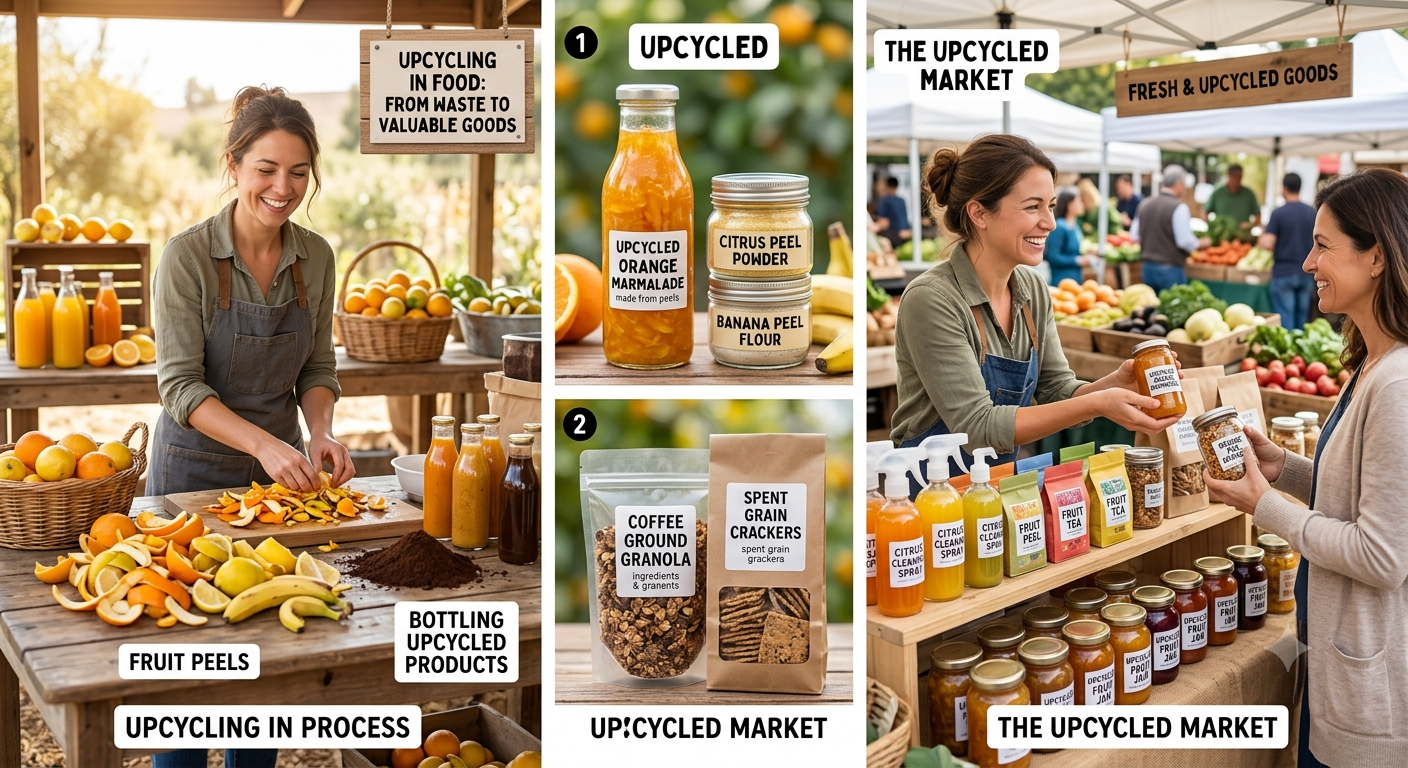
Upcycled food involves taking food side-streams and processing leftovers—ingredients that would otherwise not go to human consumption—and converting them into value-added, nutrient-rich B2B ingredients or direct-to-consumer (D2C) food products. Unlike standard food recycling (such as anaerobic digestion for bio-energy or composting), food upcycling retains biomass at its highest hierarchy of economic and nutritional value: human consumption.
For large-scale processors, beverage giants, and FMCG conglomerates in India, food upcycling addresses three crucial strategic objectives:
- Margin Expansion & Yield Optimization: Converting low-value processing waste (sold as cattle feed at ₹2–5/kg) into functional food additives, bioactive extracts, or fiber isolates (valued at ₹150–800/kg) significantly improves gross margins.
- Carbon & Water Reduction: Upcycled ingredients carry a near-zero agricultural carbon and water footprint, enabling brands to meet decarbonization and ESG benchmarks without sacrificing supply stability.
- Supply Chain Resiliency: In an era of volatile climate-driven commodity prices, upcycling creates localized, resilient ingredient streams from existing facility throughput.
Structural Challenges Hindering Large-Scale Adoption
Despite the market promise, scaling upcycled food products in India presents operational and regulatory complexities that corporate strategy teams must navigate:
- Cold-Chain & Perishability Gaps: Wet side-streams like wet brewery spent grain (80% moisture) or fresh fruit pomace spoil within 6 to 12 hours under ambient tropical temperatures. Rapid drying or cold logistics require immediate capital investment at the processing unit
- Fragmented Processing Facilities: A significant portion of primary processing in India occurs in small, decentralized clusters, making baseline volume aggregation for bio-refineries logistically challenging. Regulatory & Labeling Ambiguity: FSSAI (Food Safety and Standards Authority of India) provides clear standards for finished food categories, but explicit standard operating procedures for upcycled ingredient safety validation and consumer-facing upcycling certifications are still evolving. Consumer Perception Barrier: Indian consumers prioritize freshness. Marketing products made from “waste” or “side-streams” requires nuanced messaging that emphasizes sustainability, premium nutrition, and zero-waste ethos rather than “recycled trash.”
- Regulatory & Labeling Ambiguity: FSSAI (Food Safety and Standards Authority of India) provides clear standards for finished food categories, but explicit standard operating procedures for upcycled ingredient safety validation and consumer-facing upcycling certifications are still evolving.
- Consumer Perception Barrier: Indian consumers prioritize freshness. Marketing products made from “waste” or “side-streams” requires nuanced messaging that emphasizes sustainability, premium nutrition, and zero-waste ethos rather than “recycled trash.”
Policy Interventions & Industry Ecosystem Recommendations
Accelerating upcycling across India’s multi-billion dollar food ecosystem demands coordinated action across industry associations, government bodies, and academic institutions: FSSAI Standardized Certification: Introduction of an official “Upcycled Certified” green seal on food packaging, modeled after global standards (e.g., Upcycled Food Association), establishing safety trust and premium positioning. PLI Scheme Integration: Extending Production-Linked Incentives (PLI) to food processors investing in byproduct valorization technology and bio-refinery infrastructure.
Academic-Industry Tech Transfer: Collaborating with Premier Research Institutes like CFTRI (Central Food Technological Research Institute) and NIFTEM to license patented extraction processes for native Indian crops (e.g., jackfruit seed flour, sugarcane bagasse xylo-oligosaccharides).
Conclusion & Action Call for Corporate Leaders
The Indian food processing industry stands at a pivotal juncture. As margins tighten and sustainability commitments transition from marketing copy to core operational metrics, upcycling offers a proven, highly profitable pathway forward. By treating biomass side-streams with the same rigorous engineering, quality control, and strategic vision as primary products, corporate leaders can unlock multi-billion rupee value opportunities while steering India toward a truly circular food economy.
No Comments